Directed by: Jeff Chan
Written by: Jeff Chan, Chris Pare
Starring by: Stephen Amell, Greg Bryk, Robbie Amell
Genres: Sci-Fi
Country: Canada
Language: English
In a world where people with special abilities are living in poverty Conner Reed is a powerful young man who is struggling to pay for his ailing mother’s medical treatment. To earn money he joins a lucrative criminal world led by Garrett who works for a drug lord.
Bigil (2019) HDRip Tamil Full Movie Watch Online Free
Bigil (2019) HDRip Tamil Full Movie Watch Online Free
Directed and written by: Atlee Kumar Starring by: Nayanthara, Joseph Vijay, Jackie Shroff Genres: Action, Drama, Sport Country: India Language: Tamil
This movie revolves around on how a football player sacrifices his dream for his father, who is a gangster and who also wants his son to achieve big in football. Later, he gets a second chance to achieve his dream where he needs to coach a women’s football team to glory with many obstacles.
Tesla (TSLA) stock price is the highest it's been in 2019, closing in on 52-week high
Tesla stock (NASDAQ:TSLA) recently crossed the $360 barrier, effectively hitting a year-to-date high. If Tesla maintains this momentum, the electric car maker may find itself within striking distance of its all-time high, especially if its Q4 2019 results are positively received by the market.
Tesla opened Friday at $361.05 per share, rising as high as $365.21 as of writing. This is the highest that Tesla has been in 2019 so far, with the closest one being November 19, when TSLA stock knocked on $359.99 before closing at $359.52. In a way, this bodes well for Tesla, considering that just a couple of months ago, the electric car maker’s shares were at the $240-$250 level.
Tesla has not had an easy time in 2019, being bogged down by pessimistic outlooks from Wall Street and missed internal targets. Following a first-quarter and second-quarter loss, TSLA stock dipped so much that it traded as low as $176.99 per share on June 3. Tesla recovered in a relatively slow and steady manner, at least until its blockbuster Q3 2019 earnings, which exceeded Wall Street’s expectations.
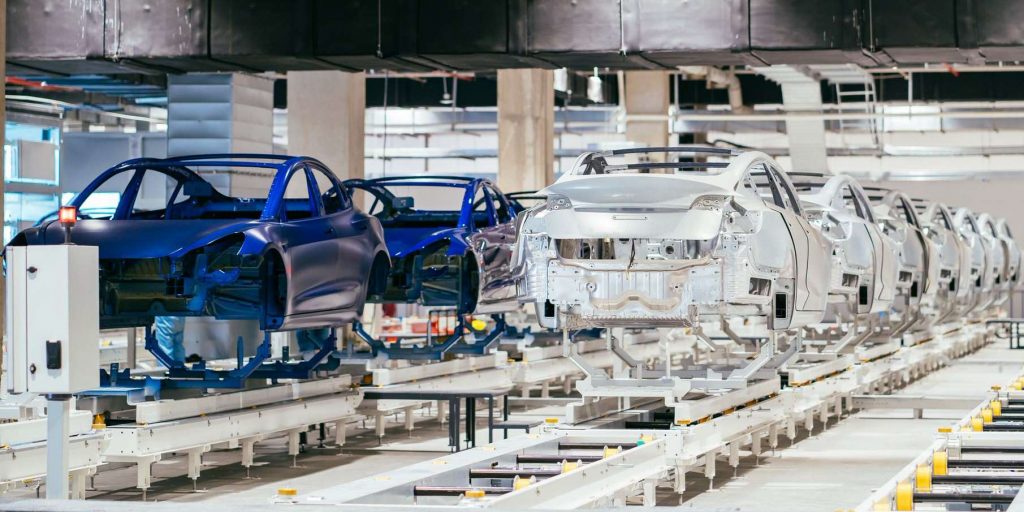
Tesla Model 3 production line in Gigafactory 3, Shanghai, China. (Credit: Tesla)
This fourth quarter, Tesla has yet another opportunity to surprise. CEO Elon Musk has been quite subdued this Q4, refraining (at least for now) from declaring hyper-ambitious targets for the company in terms of its production and delivery numbers. During the second-quarter earnings call, Musk noted that Q3 will likely be a break-even quarter, and Q4 will be profitable. These expectations were broken in the third quarter when instead of breaking even, Tesla posted a profit.
Amidst Elon Musk’s relative silence, Tesla does have some positive momentum carrying it towards the end of the year. Unlike past quarters, Tesla does not seem to be engaging in its now-trademark end-of-quarter delivery push, which involves the company going all hands on deck around the clock in a mad dash to deliver as many vehicles as possible during the final month of a quarter. It appears that deliveries are ongoing en masse this Q4, but the sense of near-desperate urgency present in past quarters does not seem to be there.
@Tesla#NoDemand-Thursday: All Tesla models, even the most expensive Performance trim, are entirely sold out in all markets outside North America, China, and New Zealand until February. #Bankwuptcy
Apart from these, signs are abounding that Tesla Model 3 demand remains healthy. As noted by observations from the Tesla community, the all-electric sedan seemed to be sold out for 2019, with only a few areas assuring customers of delivery before the end of the year. In several territories in Europe and even in Asia, Model 3 deliveries for new orders are now estimated for Q1 2020.
Tesla has also been progressing well in its efforts to expand its reach to other countries. Gigafactory 3 Phase 1 has been fully completed, and mass production of the company’s Made-in-China Model 3 has begun. Tesla has also received a license to sell the all-electric sedan locally. Furthermore, the Made-in-China Model 3 has been granted government incentives, which will likely make the vehicle more attractive to mainstream buyers. Just recently, truckloads of Tesla Model 3 have been spotted being transported from Gigafactory 3, giving the impression that initial deliveries may just be around the corner.
Of course, Tesla does need to meet its ambitious targets to fully meet its own guidance. The electric car maker has estimated that it would deliver about 360,000 to 400,000 vehicles in 2019. Following Q3’s results, Tesla will need to deliver about 105,000 vehicles in the fourth quarter to meet this goal. If it does, then it would not be surprising if Tesla stock ends up being in striking distance of its all-time-high of $383.45 per share, which was achieved on June 19, 2017.
Disclosure: I have no ownership in shares of TSLA and have no plans to initiate any positions within 72 hours.
Elon Musk gets Governor’s welcome to build Tesla Cybertruck in Alaska
The Tesla Cybertruck may be polarizing, but it is a vehicle that has captured the interest of the motoring world and beyond. And while neither Tesla nor Elon Musk has announced any details about where the upcoming all-electric pickup truck would be produced, this has not deterred a government official from extending an offer to the CEO.
In a recent tweet, Alaska governor Governor Mike Dunleavy invited Tesla CEO Elon Musk to consider utilizing the state’s resources to build the electric car maker’s premium vehicles. The governor specifically mentioned the company’s recently-unveiled Cybertruck in his offer, stating that AK stands above other areas when it comes to balancing resource development.
“Hey @elonmusk & @Tesla: Let’s talk about utilizing #Alaska’s vast resources to help build #Tesla cars and the new Cybertruck. Nobody in the world balances resource development and environmental stewardship better than us,” he wrote.
Hey @elonmusk & @Tesla: Let’s talk about utilizing #Alaska’s vast resources to help build #Tesla cars and the new Cybertruck. Nobody in the world balances resource development and environmental stewardship better than us.
Dunleavy’s invitation is quite notable considering that the governor has reportedly maintained a controversial stance on climate action, a topic that Tesla CEO Elon Musk is very particular about. Over his tenure as Alaska’s governor, critics have argued that Dunleavy’s administration has done very little to combat climate change, as shown when he disbanded the state’s climate response task force just months after assuming office.
Neither Tesla nor Elon Musk has posted a response to the governor’s open invitation so far.
Yet, behind Dunleavy’s controversies with his administration, it is difficult to deny that Tesla and Elon Musk are now being perceived as a potential economic booster for areas where its facilities are located at. Reno, NV, for example, is seeing businesses come to the area due to the presence of Gigafactory 1. A facility that produces electric cars in Alaska will likely have the same effect.
Wow! Sounds just like the Lehigh Valley Pennsylvania. More and more warehouses keep coming here and rent keep going up! Looking at 1200 a month for a decent 1 bedroom. Everyone who work in NJ ,NY or Phili comes here because it cheep
What nobody saw was all the other businesses that moved to Reno just because Tesla was here. Tesla put Reno on the map, but now we're playing catchup. The paper reports apartment complexes waiting to be built for lack of skilled carpenters. Reno is a boomtown.
The Tesla Cybertruck is Tesla’s most radical creation to date. Built with a rigid ultra-strong stainless steel exoskeleton, the all-electric pickup truck is tough and capable of being put through serious punishment. This is something that was highlighted by auto veteran Jack Rickard in a discussion on YouTube’s EVTV channel. Rickard noted that the Cybertruck’s polarizing design was not just put in place to make the vehicle unique; it is also functional.
Thanks to its polarizing XY design, the Cybertruck will not require a stamping press or a paint shop. This makes the vehicle easy to make, and this opens up the potential of a production line that is more compact and efficient than those adopted by the company for its previous cars like the Model 3. With this in mind, Tesla may be able to produce the Cybertruck in facilities that are not as expansive as the Fremont factory of Gigafactory 3 in Shanghai. This, of course, could accelerate the rollout of Elon Musk’s boldest, most futuristic vehicle to date.
Tesla Model 3 becomes first squad car for Connecticut police department
The Westport Police Department in Connecticut is adding a Tesla Model 3 to its fleet of squad cars, which is expected to begin active duty in January 2020. The all-electric sedan will be joining the departsment’s existing fleet of Ford Explorer police cruisers and currently undergoing fitement of lights, sirens, computers, high-performance tires, and weapon racks by Whelen Engineering.
Police Chief Foti Koskinas noted that the department’s decision to add a Model was based on the vehicle’s performance, five-star crash safety ratings, and advanced collision avoidance technology. He also said he “believes in being green,” but it was not a primary factor in the decision to purchase the vehicle.
Despite Tesla’s higher price point than the department’s existing fleet of $37,000 Ford Explorers, Koskinas justified Model 3’s $52,290 cost due to its fuel and maintenance savings. The Police Department also plans to install a charging station at its headquarters. “The Police Department already has a gas pump on its property, and now will be adding a Level 2 electric vehicle charger which will easily recharge the vehicle in a few hours overnight so it has a full charge each morning. There are also EV chargers available to the public at other Westport locations such as the Library, Town Hall, and both train stations,” Koskinas said.
Residents of the Westport area are supportive of the Police Department’s decision to add an electric vehicle to its fleet, especially in a town where citizens own more electric vehicles per capita than any other town in Connecticut.
Multiple police forces in the United States have chosen to use Tesla vehicles for patrol cars. The Fremont Police Department in California, located near the Tesla Factory, utilizes a Model S for patrol. Another force in Bargersville, Indiana has a Model 3 in its fleet of police vehicles. Spokespeople for both of these police departments noted the expectation that the cars would save on the cost of gas and yearly maintenance, just like the Westport PD.
The Westport PD will host an open house for residents to view the Model 3 police cruiser up close. Officers will be on-site to discuss the advantages of electric vehicles for the department.
SpaceX's East Coast Starship launch pad is making some serious headway
Over the last few weeks, SpaceX’s Florida Starship launch pad construction has made some major progress and the structure that will one day support the first East Coast Starship and Super Heavy flight tests have grown several stories tall and show no signs of slowing down.
In a bid to make what could otherwise be an extremely expensive and time-consuming ordeal much faster and cheaper, SpaceX’s Starship/Super Heavy launch pads will be quite a bit different from the company’s several existing launch pads. This includes Kennedy Space Center’s LC-39A pad, leased and operated by SpaceX for Falcon Heavy and Crew Dragon missions and formerly used for dozens of Space Shuttle launches and all Saturn V Apollo Moon missions.
In a very on-brand move, SpaceX has decided to build Starship’s East Coast orbital pad within the bounds of Pad 39A but without using the pad’s existing launch mount or concrete flame trench. Instead, SpaceX is building a separate steel mount and water-cooled thruster diverter designed to stand up to the fury of a Super Heavy booster without allowing the rocket’s plume to dig a crater in the ground after ever ignition
While choosing to pursue a dramatically different launch pad design for Starship may at first glance seem risky, SpaceX actually has more than a decade of experience building and operating similar mount and flame diverter setups at its McGregor, Texas rocket development and test facilities. A step further, NASA itself once heavily relied on similar technologies and strategies to rapidly build, test, and fly rockets larger than anything that came before them.
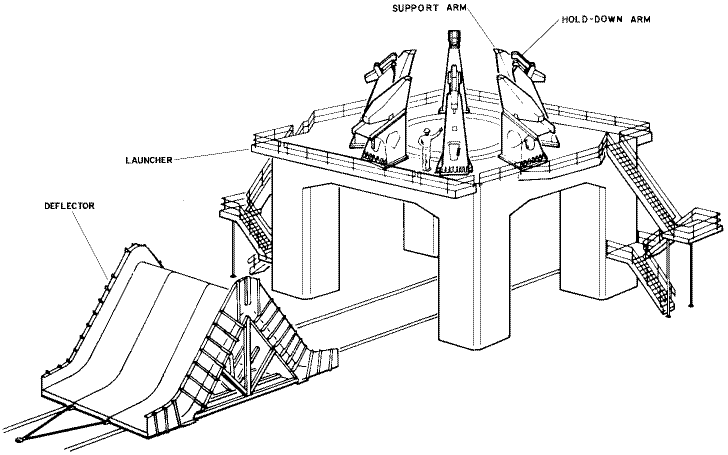
Most notably, the Saturn I rocket that preceded the massive Saturn V used a launch mount and flame diverter that looks quite similar to a conceptual setup SpaceX recently showed off in an updated Starship launch render.
Over the last few weeks, SpaceX’s Florida Starship launch pad construction has made some major progress and the structure that will one day support the first East Coast Starship and Super Heavy flight tests have grown several stories tall and show no signs of slowing down.
In a bid to make what could otherwise be an extremely expensive and time-consuming ordeal much faster and cheaper, SpaceX’s Starship/Super Heavy launch pads will be quite a bit different from the company’s several existing launch pads. This includes Kennedy Space Center’s LC-39A pad, leased and operated by SpaceX for Falcon Heavy and Crew Dragon missions and formerly used for dozens of Space Shuttle launches and all Saturn V Apollo Moon missions.
In a very on-brand move, SpaceX has decided to build Starship’s East Coast orbital pad within the bounds of Pad 39A but without using the pad’s existing launch mount or concrete flame trench. Instead, SpaceX is building a separate steel mount and water-cooled thruster diverter designed to stand up to the fury of a Super Heavy booster without allowing the rocket’s plume to dig a crater in the ground after ever ignition.
While choosing to pursue a dramatically different launch pad design for Starship may at first glance seem risky, SpaceX actually has more than a decade of experience building and operating similar mount and flame diverter setups at its McGregor, Texas rocket development and test facilities. A step further, NASA itself once heavily relied on similar technologies and strategies to rapidly build, test, and fly rockets larger than anything that came before them.
Most notably, the Saturn I rocket that preceded the massive Saturn V used a launch mount and flame diverter that looks quite similar to a conceptual setup SpaceX recently showed off in an updated Starship launch render.
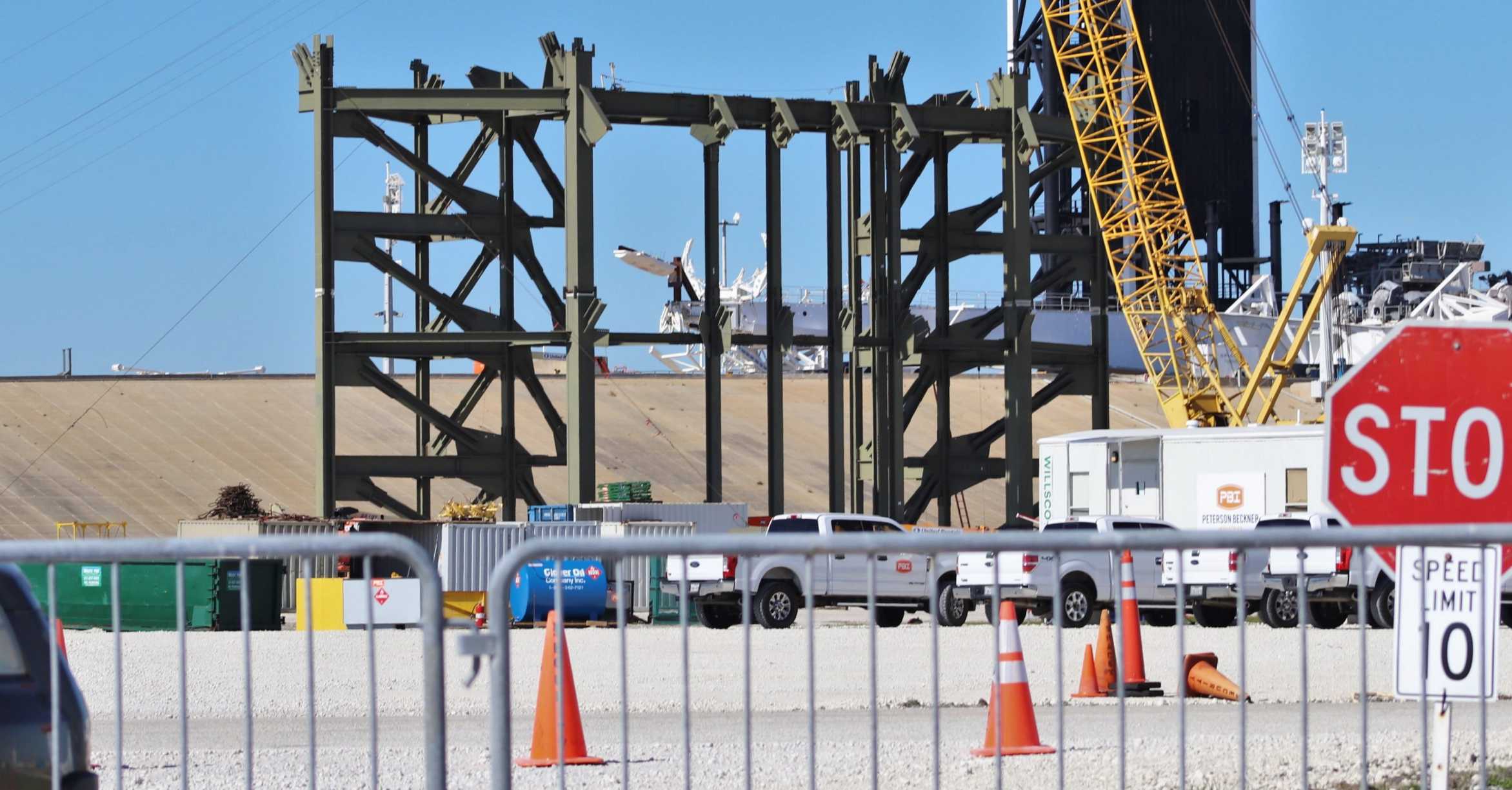
Backed by SpaceX’s Pad 39A tower and Falcon transporter/erector, technicians are busy erecting a no less massive launch mount for Starship and its Super Heavy booster. (Ciro Morales)
SpaceX’s Starship mount is substantially taller, has gone with steel instead of reinforced concrete, and will have a fixed flame deflector, but the similarities are otherwise significant. Conceptually, both mounts are topped with a flat surface with numerous support arms and a large cutout for the rocket to sit atop and its exhaust to exit through. Similar to Falcon 9, the single-core Super Heavy booster mount shown in SpaceX renders will likely have four hold-down clamps and two tail service masts (TSMs), umbilical connections that supply the rocket with propellant, electricity, connectivity, and any other required fluids.
Off the top of my head, this looks at least as tall as the mount/stand shown in SpaceX's updated 2019 renders. So it's probably safe to say that 39A is going directly to a Super Heavy-capable pad, which would make a lot of sense after the pause on FL Starship production. https://twitter.com/ABernNYC/status/1202406654844841984 …
Based on these renders, the mount shown is 80-100 ft (25-30 m) tall. Based on Adam's photo, assuming the dude getting off the lift is an average ~6 feet, the steel skeleton is already ~70 ft (21 m) tall and clearly has some mounting points for another big addition on top of that.
As described and pictured above, Starship’s Pad 39A launch mount has rapidly grown from a few metal beams into a major structure in just the last few weeks. By rough estimate, the existing mount is already 20 or so meters (70+ ft) tall and has large mounts for the installation of additional structures on top of it, while the conceptual mount shown in SpaceX renders appears to be about 25-30 m (80-100 ft) tall.
In the last few days, technicians have begun installing the first framework of the flame diverter SpaceX will use to prevent Starship from damaging itself or its surroundings during static fires and launches. Given the fact that Starship’s Super Heavy booster – as currently described – will be the single most powerful launch vehicle in history, such a vast amount of energy is not easy to dissipate. To accomplish that task, SpaceX revealed in August 2019 planning documents that the 39A diverter would be water-cooled.
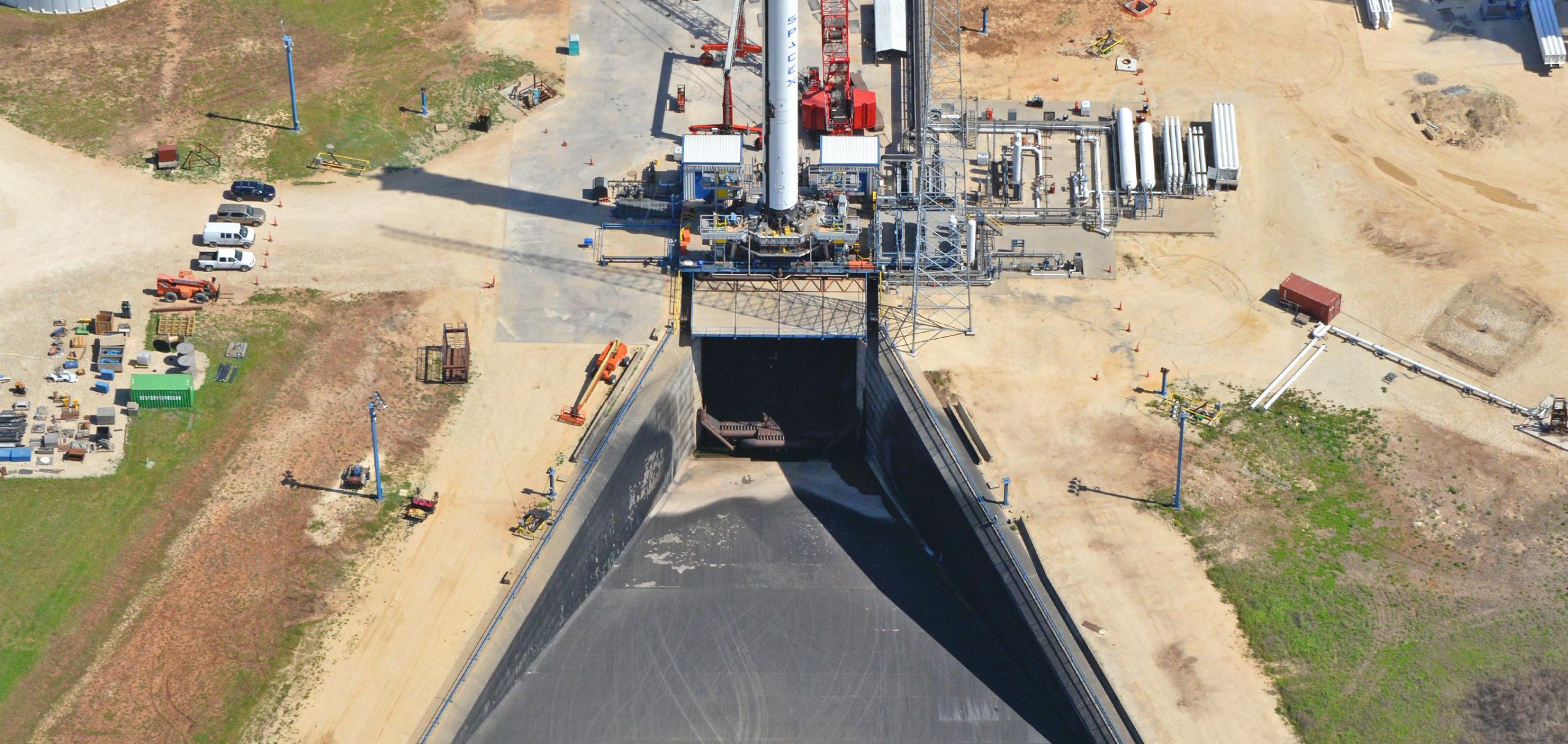
SpaceX’s McGregor, Texas booster test stand has supported dozens of Falcon 9 and Heavy static fires, thanks in large part to its massive, water-cooled thrust diverter. (Aerial Photos)
The largest thrust diverter SpaceX has built supports the company’s McGregor, Texas booster test stand and has supported dozens upon dozens of integrated static fire tests. Originally designed to enable integrated triple-booster Falcon Heavy testing, SpaceX ultimately decided not to use that capability but the diverter is still immense, likely measuring at least 15m (50 ft) tall and 10m (33 ft) wide. By building dozens of pipes into the surface and structure of the diverter and filling those pipes with recirculating water, it can survive several minutes of hot rocket exhaust without suffering catastrophic erosion or outright melting.
It’s safe to say that Super Heavy will require a diverter that is far larger still to survive thrust equivalent to more than three Falcon Heavy rockets, but that very diverter and launch mount are already well on their way to completion at SpaceX’s Kennedy Space Center launch pad.
Check out Teslarati’s newsletters for prompt updates, on-the-ground perspectives, and unique glimpses of SpaceX’s rocket launch and recovery processes.

 GET THIS TORRENT 800 mb 720p