A car’s reliability could easily determine whether a customer’s ownership experience is excellent or poor. Even simple cars could be great to own if they are reliable, and even high-performance vehicles could be a headache if they experience intermittent problems during their ownership period. This is why reliability is arguably one of the most important things that car buyers look for when purchasing an automobile.
Motoring publication What Car? Recently conducted its annual What Car? Reliability Survey, which reveals the best and worst vehicles in the UK market today when it comes to reliability. This year’s study included nearly 13,000 car owners who were asked about how dependable their vehicles have been over the previous 12 months. For this year, What Car? also decided to ask owners how much they had to pay to get their vehicles’ problems fixed, and how long the repair process took.
“In most cases, these two factors are more important than what actually went wrong with the car, because they determine how long you could be without your car and how much of a dent a fault could put in your wallet. So we used a combination of the answers to these questions to create a unique Reliability Rating – expressed as a percentage – for each model,” the publication noted.
In what could be dubbed as a pleasant surprise, the Tesla Model 3 was deemed as the most reliable executive car today in Britain, electric or otherwise. Only 5% of the Tesla Model 3 owners who participated in the survey reported having issues with their vehicle, and even then, the problems were only connected to the car’s interior trim. Despite these faults, the Model 3 owners noted that the cars could still be driven without any problems. Even better, the issues, once reported, were fixed in a day or less and at zero cost.
Highlighting this point, a Tesla Model 3 owner told the publication that “Everything about this car is superb, and I’ve had none of the build quality issues of the earlier models.” Thanks to customers’ positive response to the Model 3, the vehicle earned a stellar 99.4% Reliability Rating from What Car?’s survey, placing the vehicle ahead of all electric cars and executive vehicles, regardless of the type of propulsion.
Interestingly enough, the Model 3’s rival from Mercedes-Benz, the C-Class, was deemed by owners as the least reliable executive car. According to the motoring publication, roughly a third of C-Classes had issues, and the faults covered several aspects of the vehicle such as its electronics, exhaust, fuel system, battery, bodywork, infotainment, breaks, steering, and interior trim, to name a few. These complaints resulted in the C-Class receiving a rather low Reliability Rating of just 87.3%, far beneath the Tesla Model 3’s stellar scores.
“A third of C-Classes went wrong, according to owners, who reported a wide range of issues. Faults rendered more than a third of cars undriveable, and one in four was off the road for more than a week. Although 81% of cars were fixed for free, a small percentage of owners paid out more than £1500 in repair bills,” the publication wrote.
Tesla looks to be expanding on its Israel market presence as recent indicators point to the all-electric carmaker bringing its popular in-house insurance program into the country.
According to a report published by local news publication Globes, Tesla insurance officials have been in talks with Direct Insurance – Financial Investments Ltd., one of the largest insurance companies in Israel. The coverage is expected to be either comprehensive or vehicle-only damage protection rather than involve mandated driver, passenger, and pedestrian injury protection. Notably, Tesla has been working to expand its insurance offerings into Europe and China as well after taking off in California.
This news details yet another move by Tesla to solidify its foothold in Israel since registering its wholly-owned subsidiary, Tesla Motors Israel, at the end of last year. The entity creation resolved a legal hurdle with The Motor Vehicle Division of Misrad Hatachbura, the country’s governing body of transportation, which requires businesses to register locally if they want to import their vehicles. In addition, auto companies must also offer maintenance services if importing more than 20 cars, a requirement Tesla also looks to be addressing.
In April, the Jerusalem Post cited anonymous sources reporting that former import executive Ilan Benaro had been hired as Tesla’s technical service manager for Israel. Benaro’s duties are said to include training technical teams and setting up specialized repair shops for servicing Tesla vehicles. As part of its next steps, the company’s launch team reportedly plans to use its current stock of cars in the country for customer test drives once it begins direct marketing.
In another recent run-in with Israel’s regulatory bodies, members of its Ministry of Transport and Road Safety initially banned Tesla’s Autopilot for use after being under the impression that the system is designed to replace human driving. After explanatory talks between company representatives and ministry officials cleared up the “driver assist” intention of the feature, its use was reinstated. However, features such as Smart Summon are still not authorized.
Other manufacturers’ electric vehicles are already being sold in Israel as the country moves to have “zero pollutants” in its transportation industry by 2030. BMW, Porsche, and Renault have battery-powered cars on the road, the most affordable being a Model 3 competitor in the Renault ZOE, available for 129,990 Israeli New Shekels, or $37,431 USD. With products that match its citizens’ long-term energy goals, Tesla’s move to enter the Israeli auto market looks to be a winning strategy.
SpaceX has successfully launched a Falcon 9 rocket with 60 Starlink satellites and hopped a Starship prototype just five hours apart.
Right on schedule, Falcon 9 booster B1060 brought several days of delays to a welcome end, lifting off from Kennedy Space Center Launch Complex 39A (Pad 39A) at 8:48 am EDT (UTC-4). Nine minutes later, B1060 landed aboard drone ship Of Course I Still Love You and the mission’s expendable Falcon 9 upper stage shut off its Merlin Vacuum (MVac) engine after reaching a nominal orbit. Less than 20 minutes after liftoff, all 60 Starlink v1.0 spacecraft were successfully deployed, completing SpaceX’s 11th operational mission and 12th Starlink launch overall.
Less than five hours later, Starship prototype serial number 6 (SN6) ignited its lone Raptor engine and lifted off, soaring ~150m (~500 ft) into the South Texas sky before landing on a concrete pad a few hundred feet away. While largely unrelated from a technical and operational perspective, the back-to-back launch and hop still demonstrate one thing in particular: SpaceX remains as committed as ever to both of its most ambitious projects.
With SpaceX’s 101st launch and 60th orbital-class booster landing, the company’s Starlink satellite internet constellation now has more than 700 operational spacecraft in orbit. According to comments made earlier this year by COO and President Gwynne Shotwell, that should mean that SpaceX will be ready for the first public Starlink beta test just three or four launches from now.
SpaceX has successfully launched a Falcon 9 rocket with 60 Starlink satellites and hopped a Starship prototype just five hours apart.
Right on schedule, Falcon 9 booster B1060 brought several days of delays to a welcome end, lifting off from Kennedy Space Center Launch Complex 39A (Pad 39A) at 8:48 am EDT (UTC-4). Nine minutes later, B1060 landed aboard drone ship Of Course I Still Love You and the mission’s expendable Falcon 9 upper stage shut off its Merlin Vacuum (MVac) engine after reaching a nominal orbit. Less than 20 minutes after liftoff, all 60 Starlink v1.0 spacecraft were successfully deployed, completing SpaceX’s 11th operational mission and 12th Starlink launch overall.
Less than five hours later, Starship prototype serial number 6 (SN6) ignited its lone Raptor engine and lifted off, soaring ~150m (~500 ft) into the South Texas sky before landing on a concrete pad a few hundred feet away. While largely unrelated from a technical and operational perspective, the back-to-back launch and hop still demonstrate one thing in particular: SpaceX remains as committed as ever to both of its most ambitious projects.
With SpaceX’s 101st launch and 60th orbital-class booster landing, the company’s Starlink satellite internet constellation now has more than 700 operational spacecraft in orbit. According to comments made earlier this year by COO and President Gwynne Shotwell, that should mean that SpaceX will be ready for the first public Starlink beta test just three or four launches from now.
In May 2020, the executive noted that that public beta was expected to begin after 14 launches. Based on interactions with the FCC over the last several months, SpaceX is only counting upgraded v1.0 satellites as part of the operational Starlink constellation, meaning that Shotwell likely meant 14 Starlink v1.0 launches. Over the course of 10 Starlink v1.0 missions, only 5 of the 593 satellites launched have deorbited and burned up in Earth’s atmosphere, while another 8 satellites have lost the ability to maneuver and will likely deorbit within the next several months.
Tesla’s ability to deliver the Model Y in various trims at launch is a big deal
The initial deliveries of the Tesla Model Y are about to begin, and as more reservation holders are advised to prepare for delivery, it is becoming more evident that the electric car maker has turned a new page when it comes to its production efficiencies. If Tesla’s first wave of emails to reservation holders are any indication, it appears that the Model Y ramp will be nothing like the Model 3’s rollout.
When the Model 3 started deliveries, Tesla only offered the vehicle in one variant and one interior option: Long Range RWD with black interior. This was done to make it easier for the company to produce the sedan, especially since it was a time when Tesla was still learning how to find its stride in the production of the electric car. It was a pretty good strategy, as it allowed Tesla to find its rhythm first with Long Range RWD production before it attempted to build other, more complex variants like the Model 3 Performance with white interior, which required two motors and a different interior trim.
Reservation holders who wanted a Performance Model 3, or a Dual Motor AWD, or those who opted for Tesla’s white interior, experienced an extended wait that lasted months. Tesla started delivering the Model 3 in the second half of 2017, and customers who wanted a Performance version ended up waiting until the middle of 2018 to receive their electric car. Canadian reservation holders were in for a long wait as well.
This gradual ramp does not seem to be happening with the Model Y. If Tesla’s emails to its reservation holders are any indication, it appears that the company is preparing to deliver not just the dual-motor AWD versions of the vehicle; Performance versions will be released this coming March as well. Apart from this, reservation holders who ordered both black and white interiors have been invited to set a delivery date. But this is not all. Reservation holders in Canada have also received notifications from Tesla, informing them of upcoming Model Y deliveries.
This is something that has never really happened before, at least not at this scale. The reason behind this has not been announced by the electric car maker, though a lot of it may have to do with the Model Y sharing 75% of its parts with the Model 3, Tesla’s highest-volume vehicle available today. Tesla has already optimized its Model 3 production capabilities, after all, to the point where the company can manufacture enough vehicles to address some of the electric car’s demand in other countries. As such, developing the Model Y line may not have been as much of a challenge for the electric car maker.
Tesla has already made a lot of headway in its vehicle production efficiencies over the years. It took a while for the company to refine its Model 3 production, and it is taking all these learnings in the Model Y’s ramp. This is represented by the Model Y’s design and large casts, which are seemingly intended to ensure that the all-electric crossover could be produced in a quick and efficient manner. These will ultimately allow the company to avoid the issues that befell the Model 3’s first iterations, which were faulted by teardown expert Sandy Munro for being far too complex and heavy than it needed to be.
Simply put, the Tesla that’s about to deliver the all-electric crossover today is a far different, far more mature company as the one that tried to mass-produce the Model 3 back in 2017. This ultimately bodes well for the Model Y, considering that CEO Elon Musk expects the vehicle to outsell the Model S, Model X, and Model 3 combined. This may also send some chills down the spine of rival automakers, as Tesla’s biggest disruptor yet may end up entering key markets at a speed and scale that’s never really been seen before.
Watch Darbar Tamil Movie Online – 2020 – Rajinikanth
Darbar is a Tamil action – thriller movie directed by A.R. Murugadoss. Produced by Lyca Productions. Darbar film starring Rajinikanth, Nayanthara, Nivetha and Sunil in lead roles.
Download Darbar Movie Link Available below.
Source 1 – not working? check the other sources below.
Gemini Man (2019) BRRip Full Movie Watch Online Free
Directed by: Ang Lee
Written by: David Benioff, Billy Ray
Starring by: Will Smith, Mary Elizabeth Winstead, Clive Owen
Genres: Action, Drama, Sci-Fi, Thriller
Country: USA
Language: English
A retiring assassin Henry Brogan, finds himself pursued by a mysterious killer that can predict his every move. Discovering that he’s being hunted by a younger clone of himself, Henry needs to find out why he’s being targeted and who the creator is.
Welcome to a FREE preview of our weekly exclusive! Each week our team goes ‘Beyond the News’ and handcrafts a special edition that includes our thoughts on the biggest stories, why it matters, and how it could impact the future.
You can receive this newsletter along with all of our other members-exclusive newsletters, become a premium member for just $3/month. Your support goes a long way for us behind the scenes! Thank you.
—
A recent consumer survey conducted by Autolist.com revealed some interesting indicators about the future of electric pickup trucks. On one hand, there’s still time for legacy auto makers to read the memo about the future of their industry with regard to power source. Decades of branding and (mild) innovations could pay off for them because their customers are watching what they’re doing and extending some good will based on the reputation they’ve built. Tesla might be playing a big role in the industry’s directional change, but they don’t necessarily win customers by default because of that role.
On the other hand, car buyers (as expected) don’t seem to be that into radical changes when making a personal transportation choice, but they could be convinced over time. In fact, Autolist’s survey might show that if big truck companies either don’t play ball in the EV transition or they only play half-heartedly, their industry leadership could be chipped away until things collapse altogether.
Let’s look at the survey’s data to break down why I think these things are indicated.
Out of about 1,100 people surveyed to choose one of four electric truck options, of which there was a 50/50 split between those who’d currently/previously owned a truck and those who never had, GM’s still non-existent future truck was the highest-ranked. Ford’s F-150 and Rivian’s R1T came in the middle, and the Tesla Cybertruck was ranked last. Although GM’s vehicle is sight-unseen, the number one reason those surveyed made it their number one choice was due to their trust and existing preference for the brand. Ford’s F-150 was primarily chosen by those people for the same reason as well.
These replies indicate that the billions invested in marketing and production over the years could pay off for GM and Ford in the EV sector. However, their brands of trucks were also expected to have good performance and be reliable, the number 2 and 3 reasons they were chosen. In other words, just putting their name on a vehicle won’t be enough in the long term. In fact, the number one reason why the Tesla Cybertruck was the first choice of those people was the expected performance. The cyberpunk look of the pickup didn’t even rank, and Tesla’s other investments – Autopilot and their charging network – were tied for reasons number 2 and 3 in those customer choices. Interestingly enough, the styling of Rivian’s R1T was the number one reason it was ranked by those responders by a long shot (75%).
It seems that the traditional “look” of a truck is pretty much preferred by customers, as expected by many, but as also expected by many, the performance is important enough to turn heads in unconventional directions. I mean, this is all probably just preaching to the choir for lots of EV watchers and so forth, but seeing some data come in to validate the opinions is interesting.
Another interesting breakdown in the survey that somewhat validates both camps on whether Cybertruck can appeal to enough buyers to be considered successful is that among prior and current truck owners, only 14% preferred it over the other three options. GM’s unseen truck was preferred by 35% of respondents, Ford by 28%, and Rivian by 23%. I’d say that is definitely validation for people saying that “truck” people like their trucks to look like what they’ve come to think trucks should look like. Cybertruck, however, was the number one choice of those who’d never owned a truck before. But, I think there’s still a caveat here.
Cybertruck may have been the number one truck choice for first-time truck buyers, but that number one rank was nearly even with the other three choices. Tesla’s pickup came in at 25.8%, Rivian’s R1T was 24.8%, and the F-150 and GM trucks tied at 24.7% – all are within a percentage of one another. So, even among people that might be more open-minded about what a truck should look like, Cybertruck is still only appealing to a minority of consumers. Overall, it looks like 75% of even first time truck buyers want one that looks traditional, and 85% of current/prior truck owners want the old look as well.
Yet still, the “big guys” don’t really have the wiggle room to loose even the smaller percentage of people that want something different in a truck. As many commenters pointed out under Teslarati’s report on this survey, GM has some workforce headaches and retirement obligations that make its bottom profit line very thin.
Already, it’s tough for union-weighted factories to make significant changes to their product lineups because workers’ jobs are threatened by various parts of the innovations, thus strikes and shutdowns and bankruptcies are always looming. If GM and other companies with similar balancing acts can’t make enough changes to get their electric trucks to compete with the performance of Cybertruck (and perhaps the R1T), they’re going to leak customers where they just can’t afford to leak them, and when customers leave…so goes their money. Shareholders will only tolerate so much squeezing (or so it seems).
Tesla is already hitting hard with a $40k truck whose performance expectations are incredible. If their competition can’t play ball with those specs on something that looks traditional, losing money along the way, they could end up losing the “big” game (i.e., shut down completely) and have to bow out to Tesla and Rivian altogether. Tesla could also go in for the kill move, too, and just put something out there for the same price range and specs as Cybertruck that looks fairly “normal” to scoop up GM’s and Ford’s customer holdouts over style.
GM and LG Chem announce landmark partnership to accelerate the EV transition
Veteran American automaker General Motors and Korean battery technology company LG Chem have announced a $2.3 billion partnership that would begin the development of electric car batteries.
The joint venture will bring a new battery manufacturing plant to Lordstown, Ohio. Lordstown was previously the location of a GM plant that was active from 1966 until March 2019, when GMshut down the factorydue to declining sedan sales. The decline in sedan sales was attributed to the United States’ increasing demand for crossovers and sport utility vehicles.
The plant “will use the most advanced manufacturing processes” to efficiently create battery systems without producing excessive waste, an issue that comes with lithium-ion production. The partnership between GM and LG Chem is expected to create more than 1,100 new jobsaccording to a press release from GM.
“With this investment, Ohio and its highly capable workforce will play a key role in our journey toward a world with zero emissions,” Mary Barra, the Chairwoman and CEO of GM, said. “Combining our manufacturing expertise with LG Chem’s leading battery-cell technology will help accelerate our pursuit of an all-electric future. We look forward to collaborating with LG Chem on future cell technologies that will continue to improve the value we deliver to our customers.”
LG Chem has produced batteries for Chevrolet’s electric hatchback, the Bolt. LG Chem has also worked with a wide selection of automakers, including Ford, Hyundai, Volvo, Volkswagen, and is reportedly working withTesla’s Gigafactory 3 in Shanghai. LG Chem willprovide the 2170 lithium-ion battery cellsfor the Model 3 and Model Y, both vehicles that will be produced at Gigafactory 3.
GM plans to have at least twenty different electric vehicles on the road by 2023. The automaker is also aiming to utilize new production technology to decrease the cost of lithium-ion batteries, thus bringing down the price of its electric cars. A new Chevy Bolt’s current price is set at around $36,620, which is slightly more expensive than the off-menu Standard Range Model 3 without basic Autopilot. The Lordstown plant is expected to have an annual capacity of more than 30 gigawatt-hours.
The news of the partnership gives the impression that GM is planning for a large push into the electric vehicle market. After all, Barra said herself that the company is planning for an all-electric future. With the company positioning its new plant with LG Chem in the United States, America’s oldest car manufacturer seems to recognize the increasing popularity of electric cars, along with the environmental advantages that come with them.
Tesla nears Elon Musk’s ‘feature-complete’ Full Self-Driving suite in recent update
Tesla appears to be closing in on Elon Musk’s bold prediction that the electric car maker’s Full Self-Driving suite will be “feature-complete” by the end of the year. To become feature-complete, Tesla’s FSD suite must have the capability to navigate through city streets on its own, and it must be able to recognize stop signs, traffic lights, and other signages that it will encounter in inner-city driving.
A recent software update currently being released to the company’s fleet suggests that a feature-complete version of Full Self-Driving may indeed be rolled out to several members of Tesla’s early access program by the end of the year.
A number of Tesla owners with vehicles running the company’s NVIDIA hardware have started receiving the 2019.40.2 update. The update featured, apart from the usual improvements and bug fixes to Tesla’s software, a couple of features that will be extremely pertinent for inner-city driving. These are Adjacent Lane Speed Adjustments and Stop Sign Detection, two capabilities that would be invaluable for the company’s Full Self-Driving suite.
The following are the release notes for both of these features, as shared by the Tesla Riders Club on Twitter.
Adjacent Lane Speed Adjustments
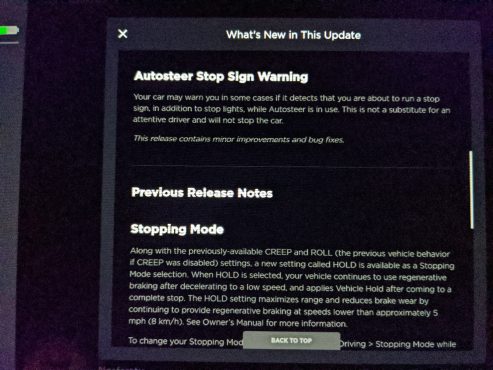
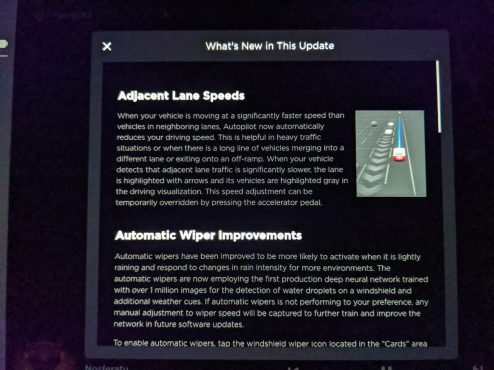
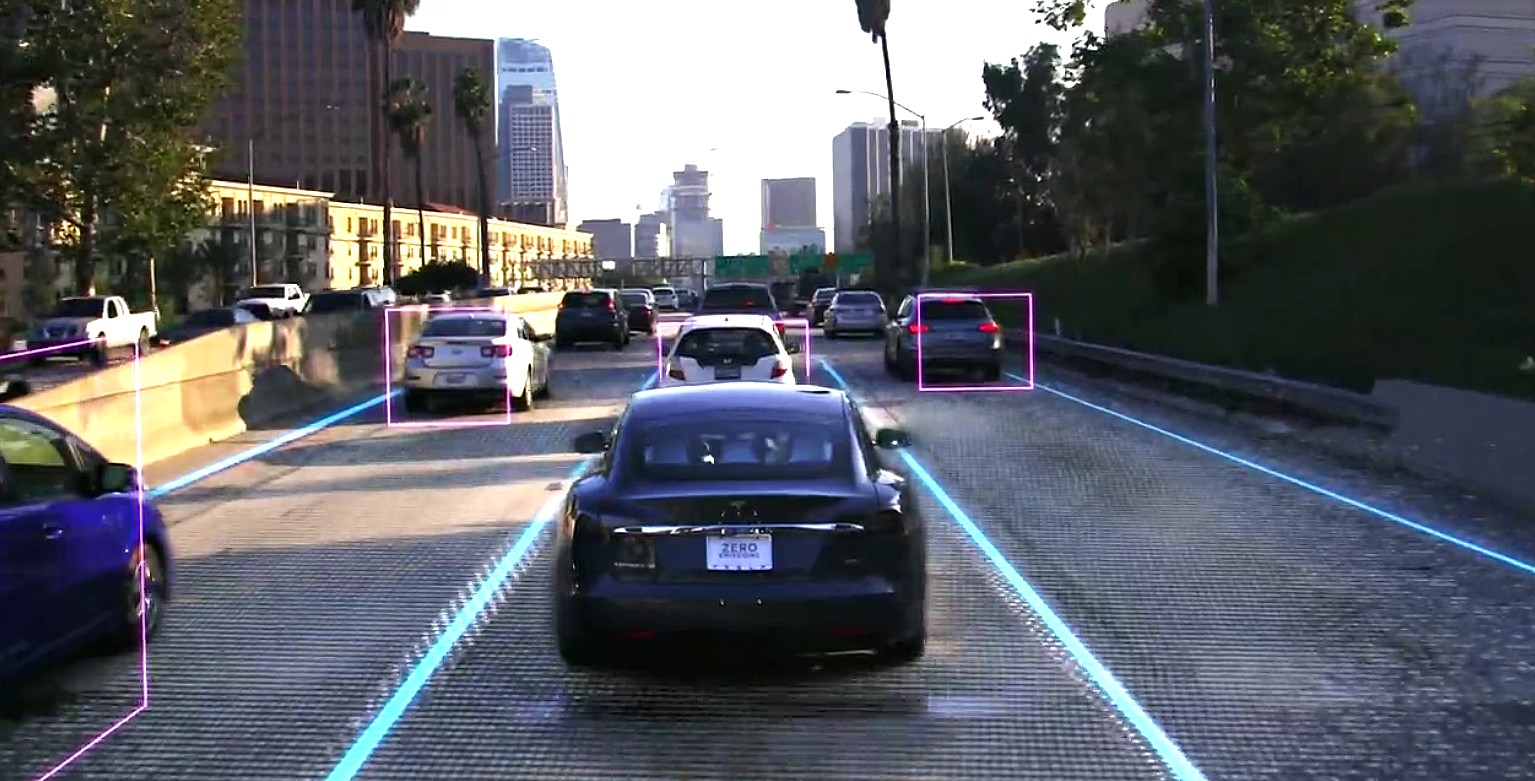
“When your vehicle is moving at a significantly faster speed than vehicles in neighboring lanes, Autopilot now automatically reduces your driving speed. This is helpful in heavy traffic situations or when there is a long line of vehicles merging into a different lane or exiting onto an off-ramp. When your vehicle detects that adjacent lane traffic is significantly slower, the lane is highlighted with arrows and its vehicles are highlighted gray in the driving visualization. This speed adjustment can be temporarily overridden by pressing the accelerator pedal.”
Autosteer Stop Sign Warning
“Your car may warn you in some cases if it detects that you are about to run a stop sign, in addition to stop lights, while Autosteer is in use. This is not a substitute for an attentive driver and will not stop the car.”
Adjacent Lane Speed Adjustments will likely be very valuable for users of Tesla’s Navigate on Autopilot with automatic lane changes. This ultimately gives users a smoother experience while using Autopilot, while providing an additional layer of safety for drivers. Autosteer Stop Sign Warning is a great companion feature to a previously released feature that allowed Teslas to detect traffic lights and alert users if they are about to run a red light. The recognition of stop signs is also an encouraging improvement for the company’s Neural Network, which appears to be learning more and more of the intricacies of everyday driving.
(Credit: Tesla)
Elon Musk has stated that he believes Full Self-Driving could be feature-complete by the end of 2019, and it would likely be rolled out to a select number of Tesla owners who are part of the early access program. Musk clarified what feature complete really means during the third-quarter earnings call.
“Yeah, feature-complete, I mean, it’s — the car is able to drive from one’s house to work, most likely without interventions. So it will still be supervised, but it will be able to drive — it will fill in the gap from low-speed autonomy — low-speed autonomy with Summon. You’ve got high-speed autonomy on the highway, and intermediate speed autonomy, which really just means traffic lights and stop signs.
“So feature-complete means it’s most likely able to do that without intervention, without human intervention, but it would still be supervised. And I’ve gone through this timeline before several times, but it is often misconstrued that there’s three major levels to autonomy. There’s the car being able to be autonomous but requiring supervision and intervention at times. That’s feature complete. Then there’s — and it doesn’t mean like every scenario, everywhere on earth, including ever corner case, it just means most of the time,” Musk said.
Rivian R1T’s new tailgate patent makes for effortless loading and unloading
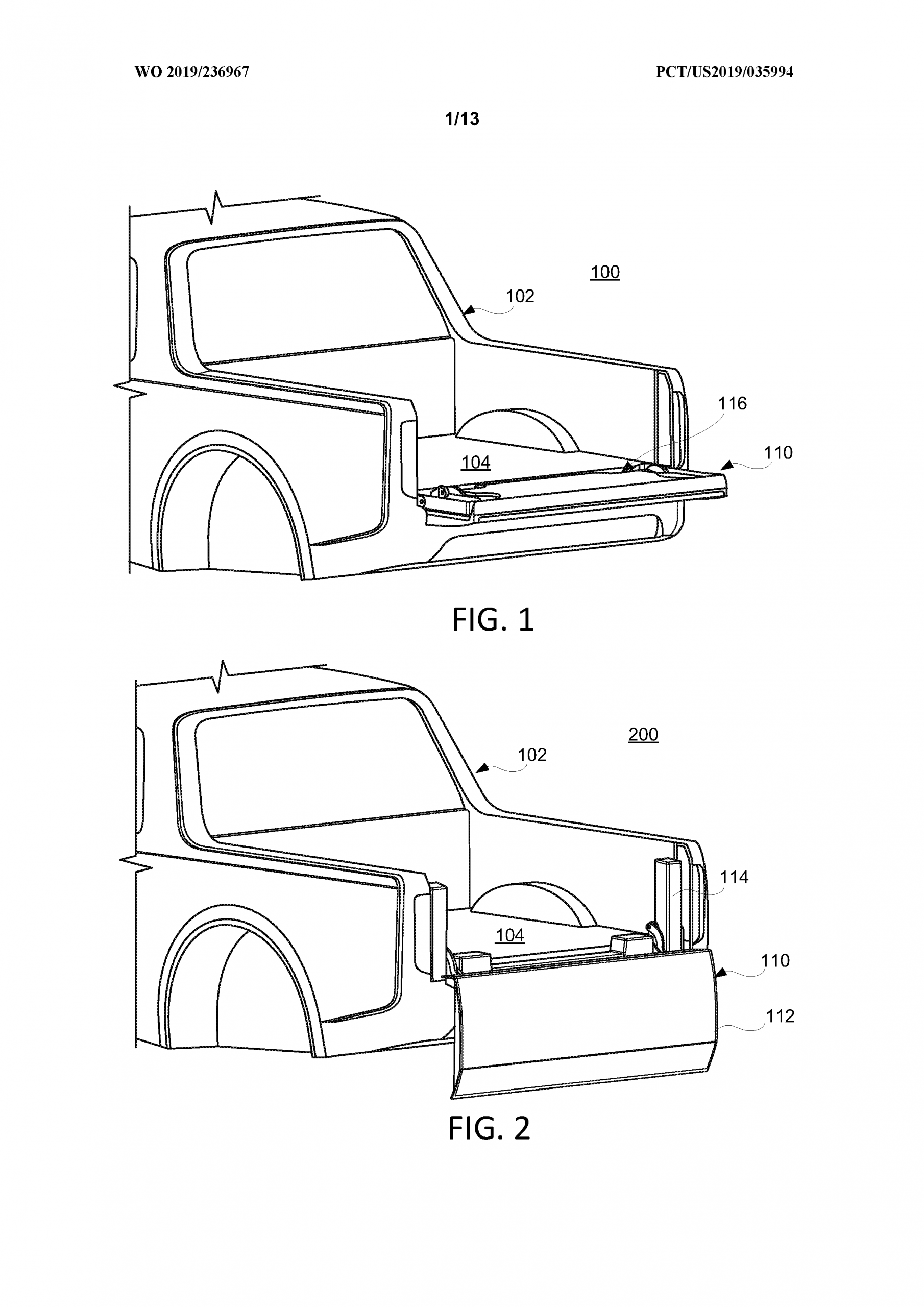
Electric car startup Rivian has submitted a patent for a “Swing and Drop Tailgate” door that would allow for easier access to the bed of the R1T pickup truck.
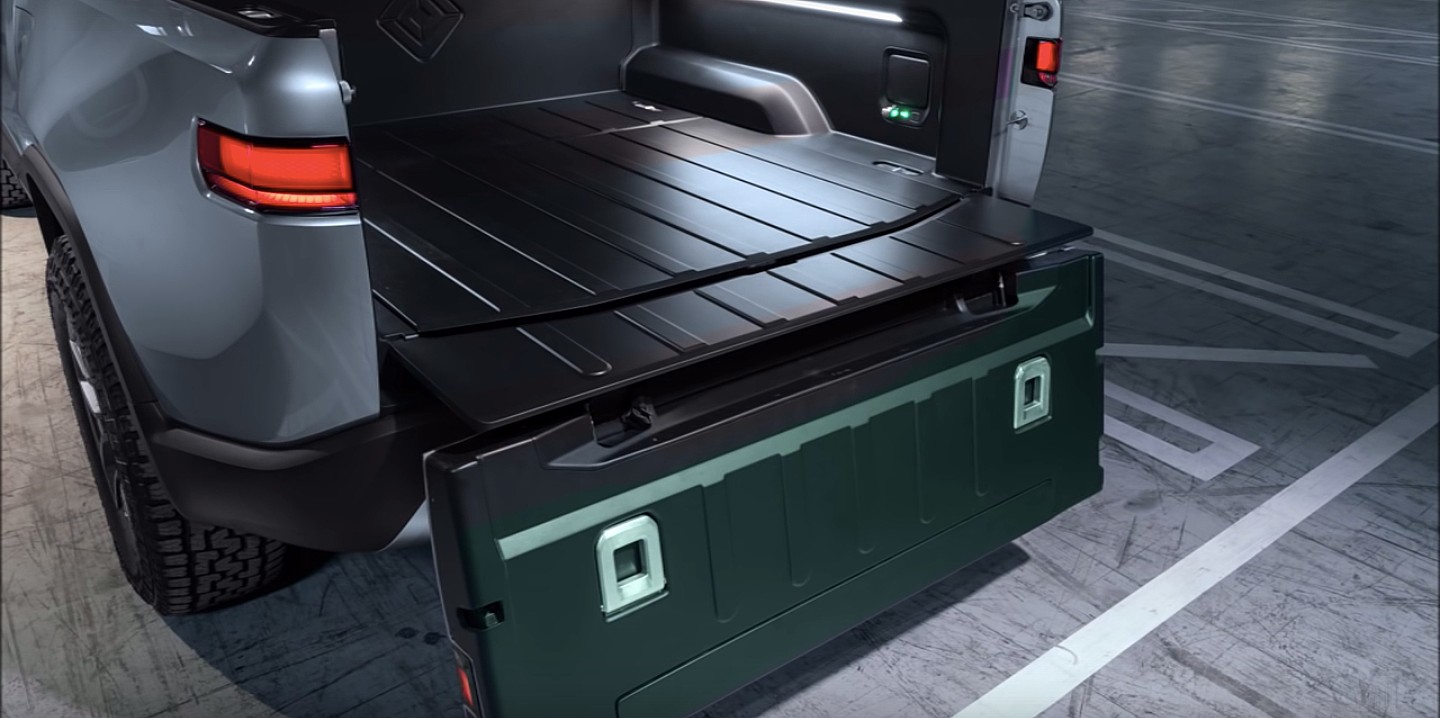
Rivian’s patent was inspired by a traditional truck’s tailgate door, which tends to restrict access to the bed of a pickup. The new design for the tailgate doorutilizes multiple hinges, allowing several different trajectories of movement and multiple resting positions. The idea behind this patent is to improve upon the traditional truck bed door design, a concept Rivian feels has drawbacks.
“One drawback to this motion is that the tailgate now protrudes rearward of the vehicle, blocking the user from standing closer to the vehicle,”the patent states.
Other truck manufacturers have seen this traditional door as a drawback and have utilized a door that opens from the side with a hinge, a setup that’s pretty much identical to a regular door that’s used in homes or buildings.
However, Rivian argues that this idea also has its issues, citing the need for excessive amounts of space to open the side-hinged door. “Other motions of a tailgate, such as a side-hinged tailgate that opens to the side may allow a user to stand closer to the vehicle, but this motion requires significant clearance and does not allow the increased horizontal space that the dropped down tailgate provides. It would be desirable for a tailgate to be capable of more than one motion, along more than one trajectory, to more conveniently adapt to a user’s needs,” the patent’s description added.
Illustrations of the new tailgate patent from Rivian show the door having the ability to open much like a traditional tailgate, but also the ability to swing down behind the rear of the vehicle. This would give a person trying to gain access to the bed the ability to get closer to the truck, allowing for easier loading and unloading of items on the R1T’s primary cargo area.
Rivian’s “Swing and Drop Tailgate” design ultimately allows the R1T’s tailgate to move in multiple different ranges of motion. This design brings several advantages, with its different movements and trajectories allowing users to not worry about the space available around them. Rivian discusses these advantages further in its patent.
“A swing and drop tailgate assembly is configured to undergo more than one motion to provide access to cargo space, for example. For example, a tailgate assembly may be arranged at a boundary of the cargo space (e.g., the rear of a vehicle bed), and is configured to undergo more than one motion to allow access to the cargo space,” the patent description says.
The initial production dates of the Rivian R1T pickup are scheduled for late 2020 or early 2021 according toRJ Scaringe, the company’s CEO. The truck has been available for viewing at a number of Rivian’s reservation holder events and will also be on location at theFully Chargedevent in Texasin February 2020. The electric pickup sports an impressive 750 horsepower, three feet of wading depth, 0-60 MPH in three seconds, and a 400+ mile range on its highest-tier variant.


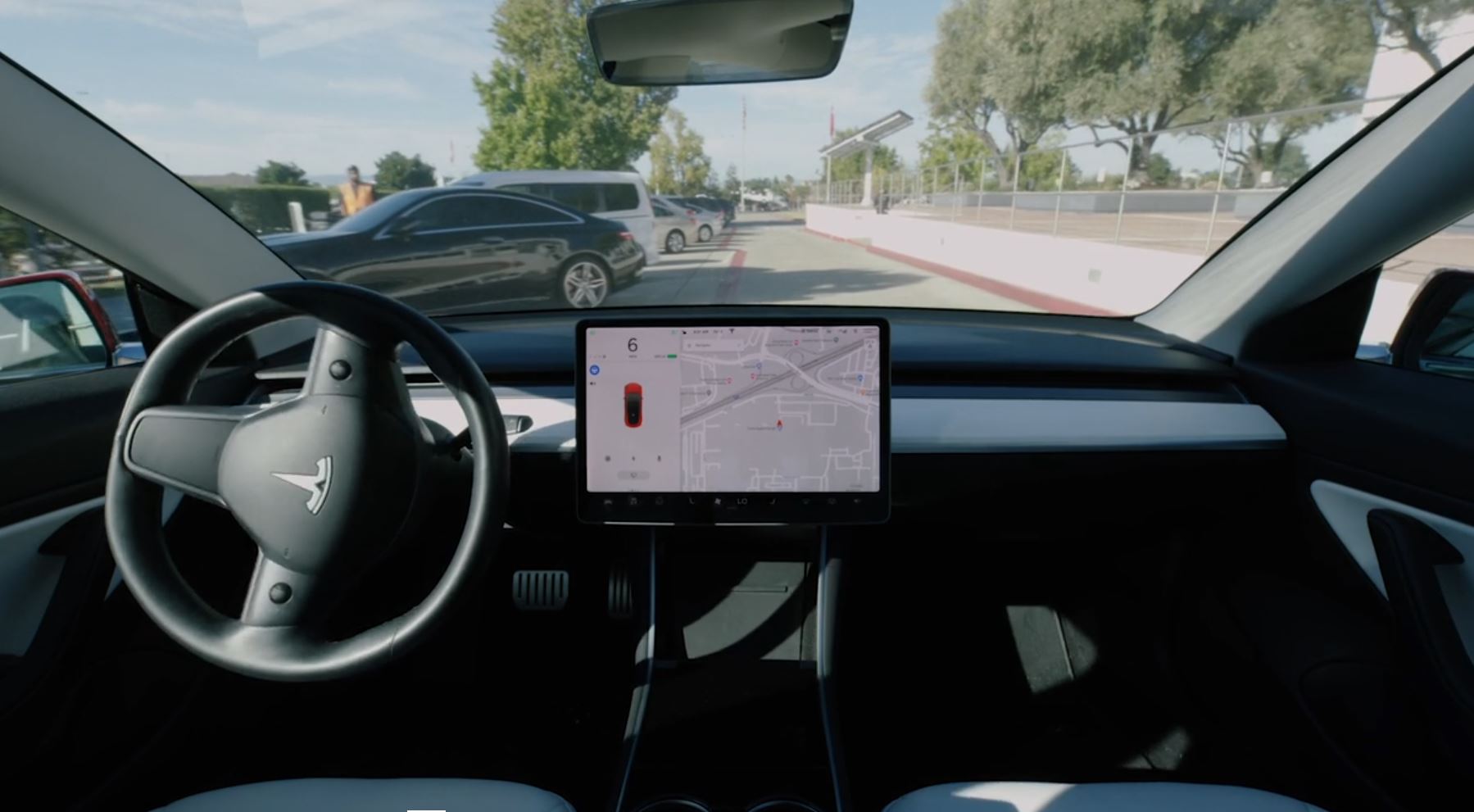


 Tesla appears to be closing in on Elon Musk’s bold prediction that the electric car maker’s Full Self-Driving suite will be “feature-complete” by the end of the year. To become feature-complete, Tesla’s FSD suite must have the capability to navigate through city streets on its own, and it must be able to recognize stop signs, traffic lights, and other signages that it will encounter in inner-city driving.
A recent software update currently being released to the company’s fleet suggests that a feature-complete version of Full Self-Driving may indeed be rolled out to several members of Tesla’s early access program by the end of the year.
A number of Tesla owners with vehicles running the company’s NVIDIA hardware have started receiving the 2019.40.2 update. The update featured, apart from the usual improvements and bug fixes to Tesla’s software, a couple of features that will be extremely pertinent for inner-city driving. These are Adjacent Lane Speed Adjustments and Stop Sign Detection, two capabilities that would be invaluable for the company’s Full Self-Driving suite.
The following are the release notes for both of these features, as shared by the Tesla Riders Club on Twitter.
Adjacent Lane Speed Adjustments
“When your vehicle is moving at a significantly faster speed than vehicles in neighboring lanes, Autopilot now automatically reduces your driving speed. This is helpful in heavy traffic situations or when there is a long line of vehicles merging into a different lane or exiting onto an off-ramp. When your vehicle detects that adjacent lane traffic is significantly slower, the lane is highlighted with arrows and its vehicles are highlighted gray in the driving visualization. This speed adjustment can be temporarily overridden by pressing the accelerator pedal.”
Autosteer Stop Sign Warning
“Your car may warn you in some cases if it detects that you are about to run a stop sign, in addition to stop lights, while Autosteer is in use. This is not a substitute for an attentive driver and will not stop the car.”
Adjacent Lane Speed Adjustments will likely be very valuable for users of Tesla’s Navigate on Autopilot with automatic lane changes. This ultimately gives users a smoother experience while using Autopilot, while providing an additional layer of safety for drivers. Autosteer Stop Sign Warning is a great companion feature to a previously released feature that allowed Teslas to detect traffic lights and alert users if they are about to run a red light. The recognition of stop signs is also an encouraging improvement for the company’s Neural Network, which appears to be learning more and more of the intricacies of everyday driving.
Tesla appears to be closing in on Elon Musk’s bold prediction that the electric car maker’s Full Self-Driving suite will be “feature-complete” by the end of the year. To become feature-complete, Tesla’s FSD suite must have the capability to navigate through city streets on its own, and it must be able to recognize stop signs, traffic lights, and other signages that it will encounter in inner-city driving.
A recent software update currently being released to the company’s fleet suggests that a feature-complete version of Full Self-Driving may indeed be rolled out to several members of Tesla’s early access program by the end of the year.
A number of Tesla owners with vehicles running the company’s NVIDIA hardware have started receiving the 2019.40.2 update. The update featured, apart from the usual improvements and bug fixes to Tesla’s software, a couple of features that will be extremely pertinent for inner-city driving. These are Adjacent Lane Speed Adjustments and Stop Sign Detection, two capabilities that would be invaluable for the company’s Full Self-Driving suite.
The following are the release notes for both of these features, as shared by the Tesla Riders Club on Twitter.
Adjacent Lane Speed Adjustments
“When your vehicle is moving at a significantly faster speed than vehicles in neighboring lanes, Autopilot now automatically reduces your driving speed. This is helpful in heavy traffic situations or when there is a long line of vehicles merging into a different lane or exiting onto an off-ramp. When your vehicle detects that adjacent lane traffic is significantly slower, the lane is highlighted with arrows and its vehicles are highlighted gray in the driving visualization. This speed adjustment can be temporarily overridden by pressing the accelerator pedal.”
Autosteer Stop Sign Warning
“Your car may warn you in some cases if it detects that you are about to run a stop sign, in addition to stop lights, while Autosteer is in use. This is not a substitute for an attentive driver and will not stop the car.”
Adjacent Lane Speed Adjustments will likely be very valuable for users of Tesla’s Navigate on Autopilot with automatic lane changes. This ultimately gives users a smoother experience while using Autopilot, while providing an additional layer of safety for drivers. Autosteer Stop Sign Warning is a great companion feature to a previously released feature that allowed Teslas to detect traffic lights and alert users if they are about to run a red light. The recognition of stop signs is also an encouraging improvement for the company’s Neural Network, which appears to be learning more and more of the intricacies of everyday driving.